Category Archives: DevOps

How Smart, Connected Products Are Transforming Companies – A New Architecture

I randomly (can you say “squirrel”) came across article entitled, ” How Smart, Connected Products Are Transforming Companies.” The article has an interesting architecture or new technology stack for handling smart, connected products. It requires companies to build and support an entirely new technology infrastructure. The entire article is a really good read.

R1411C_A2

The authors writes about the need for security:

Until recently, IT departments in manufacturing companies have been largely responsible for safeguarding firms’ data centers, business systems, computers, and networks. With the advent of smart, connected devices, the game changes dramatically. The job of ensuring IT security now cuts across all functions.

Every smart, connected device may be a point of network access, a target of hackers, or a launchpad for cyberattacks. Smart, connected products are widely distributed, exposed, and hard to protect with physical measures. Because the products themselves often have limited processing power, they cannot support modern security hardware and software.

Smart, connected products share some familiar vulnerabilities with IT in general. For example, they are susceptible to the same type of denial-of-service attack that overwhelms servers and networks with a flood of access requests. However, these products have major new points of vulnerability, and the impact of intrusions can be more severe. Hackers can take control of a product or tap into the sensitive data that moves between it, the manufacturer, and the customer. On the TV program 60 Minutes, DARPA demonstrated how a hacker could gain complete control of a car’s acceleration and braking, for example. The risk posed by hackers penetrating aircraft, automobiles, medical equipment, generators, and other connected products could be far greater than the risks from a breach of a business e-mail server.

Customers expect products and their data to be safe. So a firm’s ability to provide security is becoming a key source of value—and a potential differentiator. Customers with extraordinary security needs, such as the military and defense organizations, may demand special services.

Security will affect multiple functions. Clearly the IT function will continue to play a central role in identifying and implementing best practices for data and network security. And the need to embed security in product design is crucial. Risk models must consider threats across all potential points of access: the device, the network to which it is connected, and the product cloud. New risk-mitigation techniques are emerging: The U.S. Food and Drug Administration, for example, has mandated that layered authentication levels and timed usage sessions be built into all medical devices to minimize the risk to patients. Security can also be enhanced by giving customers or users the ability to control when data is transmitted to the cloud and what type of data the manufacturer can collect. Overall, knowledge and best practices for security in a smart, connected world are rapidly evolving.

Data privacy and the fair exchange of value for data are also increasingly important to customers. Creating data policies and communicating them to customers is becoming a central concern of legal, marketing, sales and service, and other departments. In addition to addressing customers’ privacy concerns, data policies must reflect ever-stricter government regulations and transparently define the type of data collected and how it will be used internally and by third parties.

Shared Responsibility for Security.

In most companies, executive oversight of security is in flux. Security may report to the chief information officer, the chief technology officer, the chief data officer, or the chief compliance officer. Whatever the leadership structure, security cuts across product development, dev-ops, IT, the field service group, and other units. Especially strong collaboration among R&D, IT, and the data organization is essential. The data organization, along with IT, will normally be responsible for securing product data, defining user access and rights protocols, and identifying and complying with regulations. The R&D and dev-ops teams will take the lead on reducing vulnerabilities in the physical product. IT and R&D will often be jointly responsible for maintaining and protecting the product cloud and its connections to the product. However, the organizational model for managing security is still being written.

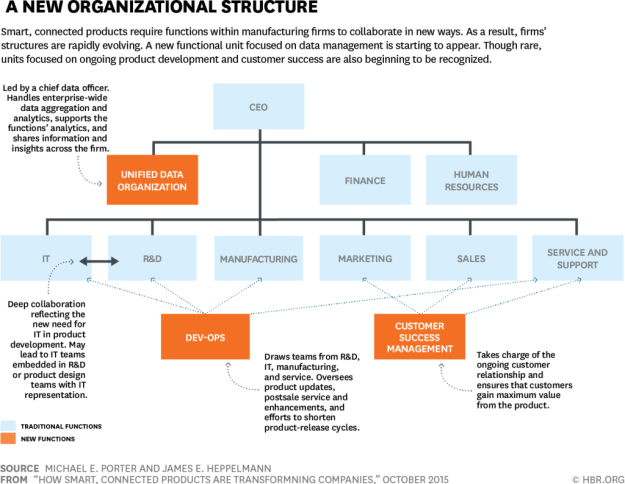
The authors continue with implications for organizational structure (i.e., The Takeaways)
R1510G_PORTER_ANEWORGANIZATIONAL-1024x794


What is causing a lack of focus in putting the right defenses in the right places in the right amounts against the right threats?

In my daily reading, the opening line and the entire post entitled, “6 reasons you’re failing to focus on your biggest IT security threats” by Roger Grimes got my attention.  The entire posting is worth a read.  Below are the highlights

Most companies are not focused on the real security threats they face, leaving them ever more vulnerable. That can change if they trust their data rather than the hype.

 Humans are funny creatures who don’t always react in their own best interests, even when faced with good, contrarian data they agree with. For example, most people are far more afraid of flying than of the car ride to the airport, even though the car ride is tens of thousands of times riskier. More people are afraid of getting bitten by a shark at the beach than by their own dog at home, even though being bitten by their dog is hundreds of thousands of times more likely. We just aren’t all that good at reacting appropriately to risks even when we know and believe in the relative likelihood of one versus the other happening.

The same applies to IT security.

Computer defenders often spend time, money, and other resources on computer defenses that don’t stop the biggest threats to their environment. For example, when faced with the fact that a single unpatched program needed to be updated to stop most successful threats, most companies do everything other than patch that program. Or if faced with the fact that many successful threats occurred because of social engineering that better end-user training could have stopped, the companies instead spent millions on everything but better training.

I could give you dozens of other examples, but the fact that most companies can easily be hacked into at will is testament enough to the crisis. Companies simply aren’t doing the simple things they should be doing, even when confronted with the data.

The problem bothered me enough that I wrote a whitepaper, slide deck, and book on the subject. Without having to read all of that, the answer for why so many defenders don’t let the data dictate their defenses is mostly about a lack of focus. A lot of priorities compete for computer defenders’ attention, so much so that the things they could be doing to significantly improve their defense aren’t being done, even when cheaper, faster, and easier to do.

What is causing this lack of focus in putting the right defenses in the right places in the right amounts against the right threats? A bunch of things, including these:

1. The sheer number of security threats is overwhelming
2. Threat hype can distract from more serious threats
3. Bad threat intelligence skews focus
4. Compliance concerns don’t always align with security best practices
5. Too many projects spread resources thin
6. Pet projects usually aren’t the most important ones

… it starts with an avalanche of daily threats and is worsened by many other factors along the project chain. The first step in fixing a problem is admitting you have a problem. If you see your company’s ineffective computer defenses represented above, now is the time to help everyone on your team understand the problem and help them to get better focus.

The Takeways

  1. Prioritize your projects.  Focus on projects that have the highest return on investment for improving the overall security posture and risk alignment
  2. Validate that your teams are working tasks related to the prioritized projects. Prioritized projects should have a smaller focus, but have aspects completed. For example, instead of deploying a database monitor solution to all of your critical databases, deploy the solution to one or two database.  The deployment should be in blocking mode and have all the operational support documents, procedures etc. completed.
  3. Leverage DevOps and Agile principles to obtain faster and incremental results as well as alignment with business
  4. Ensure the vulnerability management program is adapted and customized to your company so you can identify threats and vulnerability that are truly a priority for your team and not just hype.

Is there such a thing as Agile Security? What about DevSecOps?

There is an interesting post from Brian Forster, Fortinet, on InfoTech Spotlight.

To ensure in-depth defense during a faster deployment cycle, financial services firms have to adopt multiple security controls. This ensures that if vulnerable code delivers a great new feature but with an unknown flaw to consumers there need to be additional security measures in place that will keep it from being exploited. Combining a strong network security infrastructure with constant application and service monitoring ensures end-to-end protection as new software is deployed.

Because the DevOps approach is primarily adopted for the purpose of web application development, it’s necessary that a part of this infrastructure include a web application firewall (WAF). A next-generation WAF provides comprehensive application protection that scans for and patches vulnerabilities, and keeps applications from being exploited by the risks identified in the OWASP Top 10. Additionally, threat intelligence can be fed to the WAF to keep applications safe from even the latest sophisticated attacks. Which means that if an application is running a common exploit or is being probed by malware, the WAF will recognize it and know to deny network access to the application.

A successful DevOps program will have automation as another primary component. As code is committed to a central system by developers, an automated process looks at the submissions in the repository and builds a new version of the software.

The security protocol of DevOps initiatives will also need to be automated in order to keep up with increased volumes of both internal development and cyberattacks. Security automation capabilities are becoming more sophisticated through the use of artificial intelligence and machine learning. Eventually, this will allow for a fully automated, secure DevOps process, with the ultimate goal of enabling intent-based security.

Security and Agility

Financial services firms have a great deal to gain by adopting the DevOps approach, including remaining competitive and defending against cybercrime. When software has such a short development cycle, complete security cannot be guaranteed. For this reason, financial services firms must integrate additional network-level security controls. These controls extend security from mobile devices and IoT through the network core and out to the cloud. As financial services firms move forward with their DevOps process, the above recommendations will help construct an intelligent, integrated security system that allows agility at the same time.

The blog post missed another important ingredient: Information Security teams can learn and adopt the tenants from agile and DevOps (see for example the work by Fitzer ) Like Forster writes,

The irony here is that DevOps has also gained ground among malicious actors. New malware releases often move faster than security does. Therefore, the continuous integration and continuous deployment (CI-CD) that DevOps creates is necessary in order to keep pace with malicious actors.

The Take Aways

  1. InfoSec GRC and Security architecture teams need to review and update as needed the latest development procedures.
  2. InfoSec needs to become agile too


What are some emerging trends in cybersecurity?

I read an interesting blog post on ten cyber security trends for organizations to consider.  Please read the entire blog posting here.  Below (copied directly from blog post) are the potential trends that I find the most interesting and accurate.

A new model of cyber security will emerge
As firms invest more in cloud computing, a new model for cyber security is emerging. Increasingly, firms can look to cloud providers to embed good IT security, but firms still own the problem of setting their requirements and determining just who can access what. The shift towards DevOps and agile development build on these more flexible infrastructures, but also demand new ways of embedding security into the development lifecycle and an equally agile test regime. Security can no longer engage at the end of development cycles and, if it does, it risks being seen as a blocker rather than an enabler.

Automation of controls and compliance will be the order of the day
Firms are coming under pressure to contain their burgeoning cyber security budgets. Manpower-intensive compliance processes are beginning to give way to continuous testing and controls monitoring, helping firms build a more accurate picture of their IT estate – helping the CIO as well as the CISO. The growing demand for supply chain security and third party assurance will also lead to a burgeoning industry of testing firms offering risk scoring and testing services for those third parties.

Digital channels will demand customer centric security
Digital channels are becoming more and more sophisticated, demanding new consumer identity and access management approaches, dynamic transaction risk scoring and fraud controls, and an emphasis on usable non-intrusive security measures which don’t impact the consumer’s experience. Open Banking and the arrival of Payment Services Directive 2 will drive richer interactions between a new ecosystem of payment service providers and the banks who handle our money. A new world of open API is on the horizon, but concerns over criminal exploitation of these rich interfaces abound.

Resilience and speed matters
Regulators are focusing on resilience – the ability of an organization to anticipate, absorb and adapt to disruptive events – whether cyber-attack, technology failure, physical events or collapse of a key supplier. Exercises and playbooks are in fashion as firms try to build the muscle memory they need to respond to a cyber-attack quickly and confidently, while cyber insurance is finding its place not just as a means of cost reimbursement but as a channel for access to specialist support in a crisis.

The Takeaways

  1. Review and discuss above trends and adjust any strategy as appropriate for your organization