Category Archives: CISO

What is the CISO’s role?

In 2015, KPMG released a glossy, but informative 9 page pamphlet entitled, ” Positioning the Chief Information Security Officer (CISO) for Success.”  KPMG starts off with answering two common questions on the first page:

  1. Where should a CISO start?
  2. What should a CISO do to assure that his/her security program is a success?

The answers are interrelated. In fact, #1 is the overarching answer (and The Takeaway) are:

  1. Understand the business strategy. The IT Sec program needs to align with business needs and strategy. This makes it easier (and possible) to obtain the necessary executive sponsorship and support.
  2. Transform IT Sec capabilities.  A CISO needs move the “organizations’s capabilities [see #1] and effectively manage resources to successfully deliver programs and services that improve security posture.”
  3. Navigate change (i.e., help, facilitate and lead). IT Security needs to respond to the needs of the business strategically (see #1 above) during fundamental change (e.g. M&A, deregulation, changes in sourcing models).
  4. Deliver value with confidence.  CISO’s need to reduce risk by leveraging technology (along with education, procedures, standards, etc.). IT Security needs to enable key elements of the business strategy (ummm…see #1 above). IT Security’s services and capabilities need to be delivered with the right balance of cost and performance.

KPMG also raise two valid points about how to achieve these objectives:

  1. Prioritize efforts
  2. Moving swiftly to execute your agenda

Who was Rick Rescorla?

No simple blog post can characterize all the feelings associated with 9/11. I can only pay a simple tribute to the heroes and victims of 9/11 by reading stories related to this dark day in world history.  I am reflective and appreciative of the heroes and my freedom on this day. I teach my kids to do the same thing.

In this post, I pay tribute to Rick Rescorla.  I encourage you to read the stories posted on  http://rickrescorla.com/.

rick-rescorla

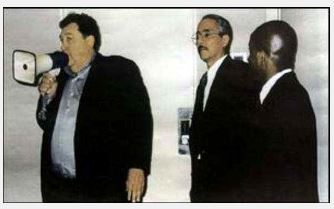
Rick Rescorla, Jorge Velazquez and Godwin Forde – leading the evacuation on 9/11 (Grunwald, 2001)

Below is an excerpt from “A Tower of Courage” by Michael Grunwald from the Washington Post (October 28, 2001).  I chose this excerpt because it has takeaways for CISOs.

___________

After the truck bombing that year, Rescorla had warned Hill: Next time by air. He expected a cargo plane, possibly loaded with chemical or biological weapons. In any case, he insisted on marching his troops through evacuation drills every few months. The investment bankers and brokers would gripe, but Rescorla would respond with his Seven P’s: Proper prior planning and preparation prevents poor performance. He wanted to develop an automatic flight response at Morgan Stanley, to burn it into the company’s DNA.

According to Barbara Williams, a security guard who worked for him for 11 years, Rescorla was in his office when the first plane hit. He took a call from the 71st floor reporting the fireball in One World Trade Center, and he immediately ordered an evacuation of all 2,700 employees in Building Two, as well as 1,000 Morgan Stanley workers in Building Five across the plaza. They walked down two stairways, two abreast, just as they had practiced. Williams could see Rescorla on a security camera with his bullhorn, dealing with a bottleneck on the 44th-floor lobby, keeping people off the elevators.

“Calm, as always,” she says.

In his cell phone call to Hill, Rescorla said he had just spoken to a Port Authority official, who had told him to keep everyone at their stations. “I said: Everything above where that plane hit is gonna collapse,” Rescorla recounted to Hill. “The overweight will take the rest of the building with it. And Building One could take out Building Two.”

That, of course, is not exactly what ended up happening. But by the time the second hijacked jet rammed into the south tower at 9:07 a.m., many Morgan Stanley employees were already out of the building, and just about all of them were on their way out.

__________

The Takeaways

  • Learn from previous attacks, including predicting potentially new ones
  • Use the Seven P’s: Proper prior planning and preparation prevents poor performance
  • Practice, practice and practice incident response plans and procedures
  • Adopt a philosophy of changing the DNA of people’s behaviors when it comes to security
  • Be prepared to handle “griping” by the individuals you are protecting
  • Use the OODA loop in incident response: Observe, Orient, Decide, Act
  • Be decisive
  • Be calm during incident


Is there a model for organizing an Information Security department?

Every CISO wonders about the following questions:

  • What key functions does my  office cover?
  • How should I structurally organize these functions?
  • Who should I seek advice, input and guidance from within the organization?
  • How can I identify gaps in my program and fill them?

On Feb 22, 2016, Nader Mehravari and Julie Allen, both from the Software Engineering Institute at Carnegie Mellon Univerity, released  a blog post and white paper to help provider answers to these questions.

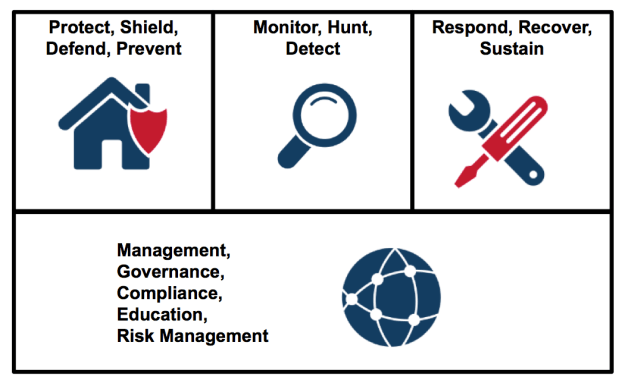
Key Functions

Screen Shot 2016-02-22 at 7.47.20 AM

4 Key Functions of CISO (Mehravari and Allen, 2016)

Organizational Chart

ciso_blog_figure2

Four Organizational Units of the CISO Office (Mehravari and Allen, 2016)

Advisory Group for the CISO

  • chief operating officer
  • chief information officer
  • chief financial officer
  • legal/privacy
  • human resources
  • communications / marketing
  • business unit VPs
  • engineering VP
  • information technology VP

Identifying and Closing Gaps

  • Map your current CISO structure to our recommended structure, departments, sub-functions, and activities
  • Determine which organizational units can continue as is, which need to change (i.e., expand or contract), and whether new units need to be created
  • Develop an implementation roadmap

The Bottom Line

  • Read the blog posting and more detailed whitepaper
  • Adapt recommendations and apply process outlined in the “Identifying and Closing Gaps” section